Pakhuis Bassein

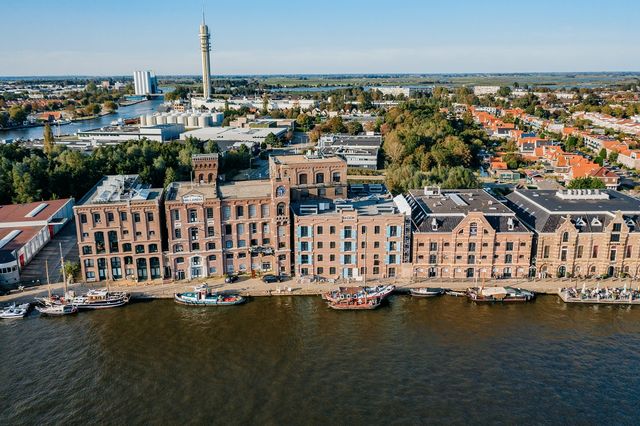
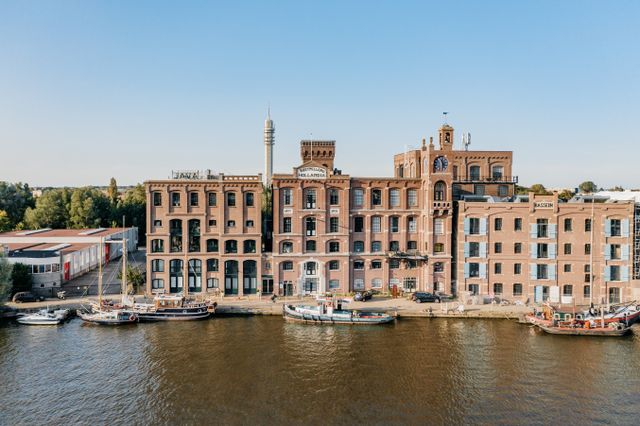
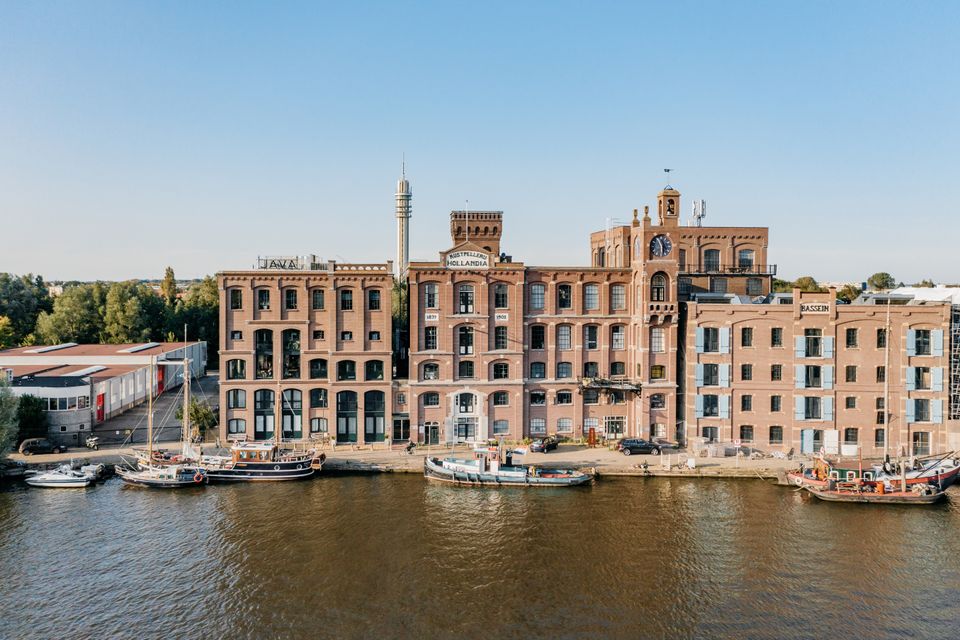
Pakhuis 'Bassein' (warehouse in the middle), built in 1898 in a transitional style with Neo-Romanesque elements, is an iconic part of the 'Hollandia' milling complex. Originally it had three storeys with a flattened gable roof, but in 1905 the building was raised by an additional storey and given a flat roof. A rectangular extension to the rear followed in 1909. The left side facade still shows the original 1898 building style, which distinguishes 'Bassein' as a historic industrial heritage building on the Zaan bank. Linked to the warehouses 'Saigon' and sandwiched between 'Hollandia I' and 'Hollandia II', it is a tangible reminder of the heyday of rice husking in Wormer.
With the demise of the Zaanse rice pil...
Pakhuis 'Bassein' (warehouse in the middle), built in 1898 in a transitional style with Neo-Romanesque elements, is an iconic part of the 'Hollandia' milling complex. Originally it had three storeys with a flattened gable roof, but in 1905 the building was raised by an additional storey and given a flat roof. A rectangular extension to the rear followed in 1909. The left side facade still shows the original 1898 building style, which distinguishes 'Bassein' as a historic industrial heritage building on the Zaan bank. Linked to the warehouses 'Saigon' and sandwiched between 'Hollandia I' and 'Hollandia II', it is a tangible reminder of the heyday of rice husking in Wormer.
With the demise of the Zaanse rice husking plant, the industrial wall on the Veerdijk also seemed to be in jeopardy. The premises became vacant in the 1960s. They fell into disrepair and in 1978 the Wessanen company (Bloemendaal & Laan's neighbour) ordered the demolition of the Siam, De-Hoop, Burmah, Indië, Rouhn and De Unie buildings. Thanks to the placement of the remaining properties on the provincial monument list in 1968, further demolition was prevented. By 1973, the firm Constant had already started manufacturing furniture in pakhuis Java . The firm grew to such an extent that warehouses Bassein also continued to manufacture oak tables.
The spaces that became vacant in the following years were rented out to artists. Since 2009, the property has had a different owner. Mr J. Constant sold it to the triumvirate B. van Borkulo, G. kramer & A.K.Kramer who intend to refurbish the former rice warehouse in the future.
Image- Nander de Wijk